
Avenue of the Dead
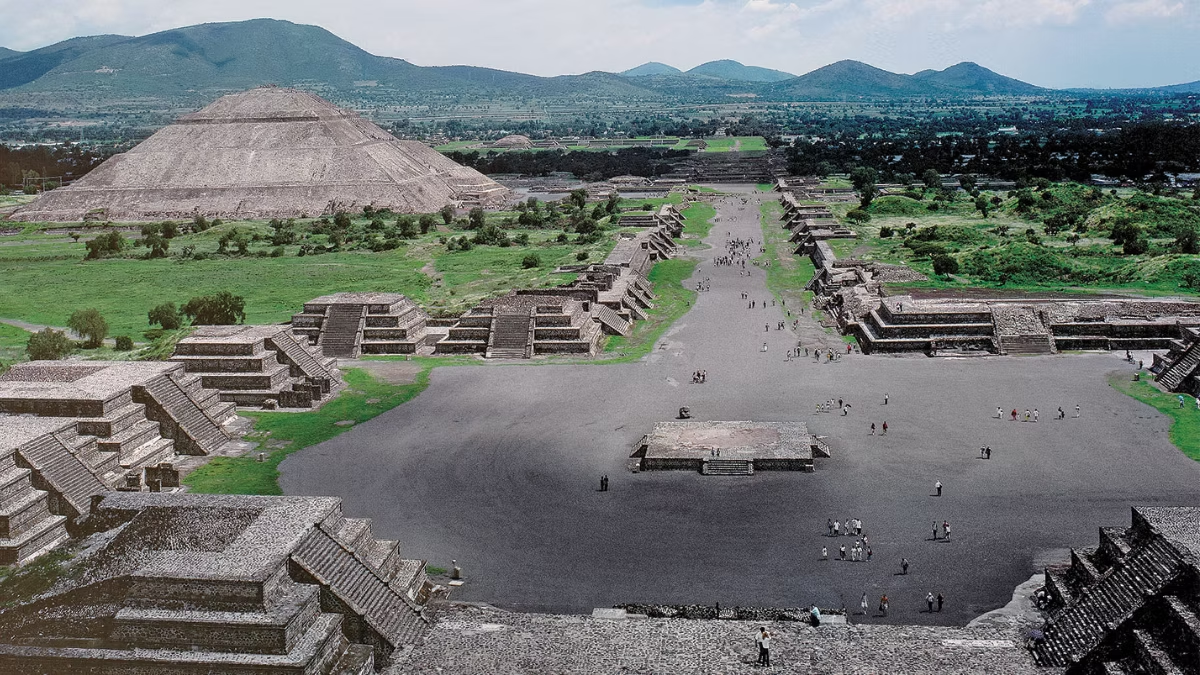
The Avenue of the Dead (Calzada de los Muertos) is the central ceremonial boulevard of Teotihuacan — a 2.4-kilometre axis running north–south through the heart of the ancient city. It connects the Ciudadela and the Temple of Quetzalcóatl at the southern end to the Pyramid of the Moon at the northern terminus. The Pyramid of the Sun sits on the eastern side of the avenue mid-way along its length. Walking the full avenue takes approximately 30–40 minutes at a relaxed pace. The name was given by the Aztecs, who mistakenly identified the flanking platforms as burial mounds — they are not graves.
If there is a single experience that defines a visit to Teotihuacan, it is walking the Avenue of the Dead. The 2.4-kilometre boulevard does not simply connect the site’s major structures — it is the spine of the entire ancient city, the axis around which one of the largest urban environments in the ancient world was organised. Walking it is not a route between highlights; it is the highlight itself.
The scale becomes real as you walk. The platforms flanking the avenue are not decorative — they are the foundations of temples, palaces, and ceremonial spaces that once stood fully intact. The Pyramid of the Sun rises on the right as you walk north, growing larger with each step until you reach its base and look up at 65 metres of ancient stone. The Pyramid of the Moon draws you forward at the northern end, growing steadily in the frame until it fills the sky. The avenue between them is not empty space — it is an architectural experience designed specifically to be walked.
Key Facts
| Feature | Detail |
|---|---|
| Length | Approximately 2.4 kilometres (1.5 miles) |
| Width | Approximately 40 metres at its widest |
| Orientation | 15.5 degrees east of true north |
| Southern terminus | The Ciudadela and Temple of Quetzalcóatl |
| Northern terminus | Pyramid of the Moon and Plaza de la Luna |
| Key structure on eastern side | Pyramid of the Sun |
| Walking time (full length) | 30–40 minutes at a relaxed pace |
What Does “Avenue of the Dead” Mean?
The name Calzada de los Muertos was given by the Aztecs, who visited the long-abandoned city centuries after its decline. They interpreted the raised platforms flanking the boulevard as burial mounds — tombs of the ancient dead. Modern archaeology has established that these are almost entirely ceremonial platforms, residential palaces, and ritual structures — not graves. The name has endured despite being based on a misidentification. The original name used by the city’s builders is unknown.
The misidentification is understandable. The platforms along the avenue are low, wide, and regular in their arrangement — from a distance and without excavation, they do resemble burial mounds. The Aztecs, arriving at a city whose builders had been gone for centuries and whose purpose was entirely unknown to them, made a reasonable interpretive leap. It was simply wrong.
What archaeology has revealed beneath and within these platforms is far more interesting: temples, palaces, workshops, residences, offering deposits, and the complex social infrastructure of a city that at its peak supported a population larger than contemporary Rome.
History of the Avenue
The Avenue of the Dead was not built all at once. Like the pyramids it connects, it was developed over several centuries as Teotihuacan grew from a regional centre into the dominant power in Mesoamerica.
The earliest phases of the avenue’s development date to approximately 100 BC–100 AD, when Teotihuacan was beginning to consolidate its urban form. By the city’s peak — between approximately 200 and 550 AD — the avenue had reached its full extent and the platforms flanking it were occupied by a dense concentration of ceremonial and elite residential architecture.
The avenue’s orientation — 15.5 degrees east of true north — is one of Teotihuacan’s most studied features. This deviation from the cardinal directions is not random: it aligns with the setting point of the Pleiades on the date they first appeared above the horizon in the pre-Columbian calendar, and with the rising and setting of the sun on specific dates of agricultural and ritual significance. The same orientation governs the layout of the entire city — streets, compounds, and structures are aligned to this grid, making Teotihuacan one of the most extensively planned cities of the ancient world.
What to See Along the Avenue
The Ciudadela and Temple of Quetzalcóatl (Southern End)
The southern approach to the Avenue of the Dead begins at the Ciudadela — a large enclosed compound covering approximately 160,000 square metres. Within it stands the Temple of Quetzalcóatl (the Feathered Serpent Pyramid), the most elaborately decorated structure at Teotihuacan. The alternating feathered serpent and rain deity heads carved into its facade are among the finest examples of Teotihuacan sculptural art and reward close examination.
The Ciudadela is the logical starting point for a north-to-south understanding of the city — it anchors the southern end of the avenue and establishes the scale of what follows. Most guided tours begin here before walking north.
The Great Compound (Opposite the Ciudadela)
Across the avenue from the Ciudadela sits the Gran Conjunto — the Great Compound — a massive platform complex believed to have functioned as the city’s primary marketplace and administrative centre. The scale of this compound, comparable to the Ciudadela, reflects the dual nature of the avenue as both a ceremonial and a commercial axis.
The Viking Group and Superimposed Buildings
Mid-way along the avenue, on the western side, the Viking Group and the Superimposed Buildings compound provide a close-up view of the layered construction techniques that built Teotihuacan over centuries. Here you can see earlier structures preserved beneath later additions — the archaeological stratification made visible. These complexes are less visited than the main pyramids and are worth a deliberate stop.
The Pyramid of the Sun Plaza
The largest open space along the avenue is the plaza surrounding the base of the Pyramid of the Sun. Approaching the pyramid from the avenue makes its scale register properly in a way that arriving directly from Gate 3 does not — the gradual growth of the structure as you walk north along the avenue is an architectural experience that the builders almost certainly designed deliberately.
The Plaza de la Luna and Pyramid of the Moon
The avenue terminates at the Plaza de la Luna — an enclosed ceremonial space framed by smaller platforms and altars that sets up the Pyramid of the Moon as the visual terminus of the entire urban axis. Standing here and looking south gives the single most comprehensive view of the avenue’s full extent available from ground level.
How to Walk the Avenue
Walking the full 2.4 kilometres at a relaxed pace without stops takes approximately 30–40 minutes. With stops at the Ciudadela, the Viking Group, the Pyramid of the Sun plaza, and the Plaza de la Luna, allow 2–3 hours for the full route.
The recommended direction is south to north — starting at the Ciudadela and ending at the Pyramid of the Moon. This follows the logical narrative of the city’s design, building from the elaborately decorated Temple of Quetzalcóatl through the avenue’s flanking platforms to the grand terminus at the Moon Pyramid. It also means you finish at a high point (literally — the Moon Pyramid’s summit) with the full view south along the avenue as your final image of the city.
North to south is equally valid if you are entering from Gate 4 near the Moon Pyramid and want to work your way toward the Ciudadela. The view south along the avenue from the Moon Pyramid’s upper platforms before descending is an excellent way to orient yourself before walking the route in detail.
Gate recommendations: – Gate 1 — closest to the Ciudadela; best for south-to-north walk – Gate 4 — closest to the Moon Pyramid; best for north-to-south walk – Gate 3 — deposits you mid-route near the Pyramid of the Sun; good if the Sun Pyramid is your primary interest
For the full gate layout, see our Teotihuacan Pyramids map guide.
The Acoustic Phenomenon
One of the Avenue of the Dead’s lesser-known features is an acoustic phenomenon that several researchers have documented: standing at specific points along the avenue — particularly at the centre of certain plazas — and clapping produces an echo that mimics the chirp of the quetzal bird. The same effect is documented at the Pyramid of the Sun base.
Whether this was intentional — built into the architecture by Teotihuacan’s designers — or coincidental is debated. The quetzal was a sacred bird in Mesoamerican culture and its presence in Temple of Quetzalcóatl‘s name is not accidental. A good guide will demonstrate this phenomenon at the appropriate point on the avenue — it is one of those small details that makes the ancient city feel genuinely alive rather than merely old.
What a Guide Adds on the Avenue
Walking the Avenue of the Dead with a certified guide transforms the experience from an impressive walk into a coherent narrative. The key things a good guide explains along the route include the astronomical grid and what the avenue’s orientation encodes, the function of the flanking platforms and what the Aztec name gets wrong, the social stratification implied by which compounds were located closest to the avenue’s central axis, the relationship between the avenue’s dimensions and Teotihuacan’s unit of measurement, and the evidence for large-scale public ceremonies and processions that would have used the avenue as their stage.
For full guided tour options from Mexico City, see our Teotihuacan Pyramids guided tour guide.
Frequently Asked Questions
How long is the Avenue of the Dead?
Approximately 2.4 kilometres (1.5 miles) from the Ciudadela at the south to the Pyramid of the Moon at the north. The full ancient avenue may have extended further in both directions — archaeologists believe the visible section is the ceremonial core of a longer urban axis.
Is the Avenue of the Dead actually a road?
It functions as a road in the sense of being a thoroughfare, but its primary purpose was ceremonial. At 40 metres wide in places, it was far broader than any practical road requires. The scale is consistent with a space designed for large public gatherings, processions, and ritual events — not simply for moving people from one end of the city to the other.
Why is the Avenue of the Dead not aligned with true north?
The 15.5-degree deviation east of north is believed to encode astronomical alignments — specifically the rising of the Pleiades on the date they first appeared above the horizon in the Mesoamerican calendar, and the rising and setting points of the sun on specific dates of agricultural significance. The entire city grid follows this same orientation.
Can I walk the entire Avenue of the Dead on a standard guided tour?
Most guided tours walk the full length of the avenue as part of the standard route. The walk from the Ciudadela to the Moon Pyramid and back takes approximately 2.5–3 hours with a guide, including stops at the main structures. Some faster-paced tours may not cover the full route to the Ciudadela — check the itinerary when booking.
What is at the southern end of the Avenue of the Dead?
The Ciudadela — a large enclosed compound containing the Temple of Quetzalcóatl (Feathered Serpent Pyramid). This is the most ornately decorated structure at Teotihuacan and one of the highlights of the full site visit. Full details in our Temple of Quetzalcóatl guide.
