
The History & Civilization of Teotihuacan
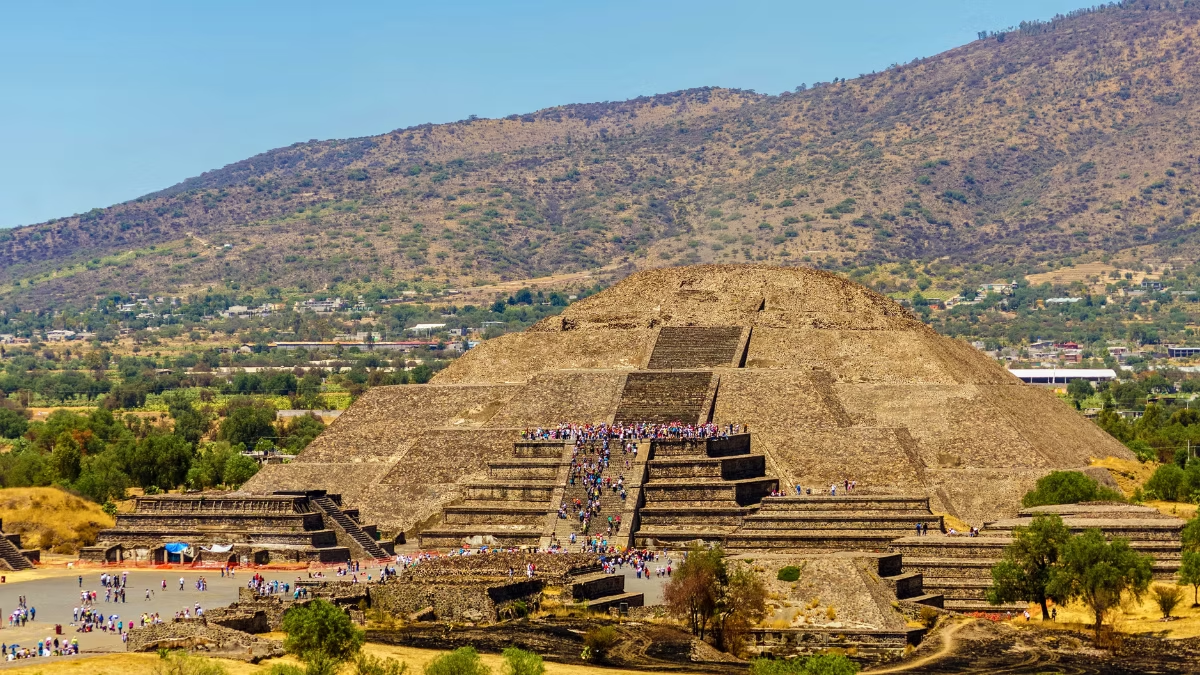
Teotihuacan was founded around 100 BC in a high-altitude valley northeast of modern Mexico City. By 200–450 AD it was home to between 100,000 and 200,000 people — one of the largest cities in the ancient world. The civilisation built the Pyramid of the Sun, Pyramid of the Moon, and the Avenue of the Dead, and its cultural influence extended across Mesoamerica. Around 550 AD, the city centre was deliberately burned and largely abandoned. Who built it, what language they spoke, and exactly why they left remain among archaeology’s most compelling unsolved questions.
Teotihuacan is one of the great mysteries of the ancient world. Vast enough to have rivalled Rome at its peak, sophisticated enough to have influenced architecture and iconography across an entire continent, and old enough that by the time the Aztecs arrived centuries after its abandonment, it had already passed entirely out of living memory — yet the people who built it left no decipherable writing, no portraits of their rulers, and no explicit accounts of their history.
What we know comes entirely from the buildings themselves, the objects buried within them, and the patient work of archaeologists who have been excavating the site since the 19th century. What they have found is extraordinary. What remains unknown may be even more so.
Timeline at a Glance
| Period | Date Range | Key Development |
|---|---|---|
| Pre-urban settlement | 600–100 BC | Small villages in the Teotihuacan Valley |
| City formation | 100 BC–100 AD | Rapid population growth; early pyramid construction begins |
| Early growth | 100–200 AD | Pyramid of the Sun constructed; Avenue of the Dead established |
| Peak period | 200–550 AD | Maximum population; Temple of Quetzalcóatl built; influence across Mesoamerica |
| Decline and collapse | 550–650 AD | City centre deliberately burned; population disperses |
| Post-collapse | 650–1300 AD | Reduced occupation; site becomes sacred to later cultures |
| Aztec period | 1300–1521 AD | Aztecs visit, name the site, incorporate it into their cosmology |
| Colonial and modern | 1521–present | Spanish documentation; systematic archaeology from 1880s |
Origins: Before the City
The Teotihuacan Valley has been occupied since at least 600 BC, when scattered agricultural villages were established in the fertile highland basin. The city itself — as a planned urban centre — began to take form around 100 BC, with the most rapid phase of construction and population growth occurring between approximately 100 BC and 200 AD.
The Teotihuacan Valley sits at approximately 2,300 metres above sea level, approximately 50 km northeast of the Basin of Mexico where Mexico City now stands. The valley’s appeal for early settlers was practical: fertile volcanic soil, reliable water sources from springs and seasonal rivers, and obsidian deposits in the surrounding hills — obsidian being one of the most valuable materials in the ancient Mesoamerican world.
What triggered the transformation of this valley from a collection of villages into one of the ancient world’s largest cities is not fully understood. A leading hypothesis is that a catastrophic volcanic eruption — possibly of Xitle, south of the Basin of Mexico, around 100 BC — forced large populations to flee northward into the Teotihuacan Valley, creating the sudden demographic pressure that drove rapid urban development. Whether this was the cause or one factor among many remains debated.
The City Takes Shape: 100 BC–200 AD
The founding generation of Teotihuacan’s urban phase — perhaps spanning two or three centuries — produced the city’s defining architectural achievements in an extraordinarily compressed period. The Avenue of the Dead was established with its distinctive 15.5-degree orientation, encoding astronomical relationships into the city’s primary axis. The Pyramid of the Sun was constructed — an engineering feat of astonishing ambition, moving an estimated 1.2 million cubic metres of earth and stone without wheels, draft animals, or iron tools.
The deliberate choice to build the Pyramid of the Sun above a natural cave — a lava tube running approximately 100 metres beneath the structure — suggests that the site was already considered sacred before the pyramid was built, and that the pyramid was designed to mark and amplify a pre-existing sacred geography.
By 100 AD, the city’s basic urban plan was established. The grid orienting buildings and streets to the 15.5-degree axis extended across the entire city — a planning ambition unprecedented in the ancient Americas.
The Peak: 200–550 AD
At its maximum extent, around 400–500 AD, Teotihuacan covered approximately 20–25 square kilometres and supported a population estimated between 100,000 and 200,000 people. This made it one of the five or six largest cities in the world at that time — larger than contemporary Rome by some estimates, and certainly the largest city in the western hemisphere.
The city at its peak was a genuinely cosmopolitan urban centre. Archaeological evidence for distinct residential quarters associated with specific ethnic and occupational groups has been found — a Zapotec neighbourhood from Oaxaca, a neighbourhood associated with Gulf Coast peoples, merchant quarters, craft production districts specialising in obsidian, ceramics, and textiles. Teotihuacan was not an isolated regional centre but a city that drew people, goods, and ideas from across the Mesoamerican world.
Political structure: Despite the city’s scale, we know almost nothing about its political organisation. There are no portraits of named rulers — unlike the Maya, who were contemporaries of Teotihuacan and whose kings are depicted extensively in stone and in painted texts. Teotihuacan produced no decipherable writing and no explicit representation of individual political authority. Whether the city was ruled by a king, a council, a priestly class, or some other system remains unknown.
Religious life: The murals at Tepantitla, Tetitla, Atetelco, and other residential compounds depict a rich religious world centred on a pantheon that includes the Feathered Serpent, a Storm Deity, and — in the interpretation of many researchers — a principal Great Goddess. The Temple of Quetzalcóatl was dedicated with large-scale human sacrifice. The Pyramid of the Moon contains a sequence of sacrificial burial chambers associated with each major construction phase. Religion was not separate from political power at Teotihuacan — the pyramid-building programme was simultaneously architectural, astronomical, ritual, and political.
Mesoamerican influence: Teotihuacan’s influence extended across Mesoamerica in ways that archaeology continues to reveal. Teotihuacan-style architecture appears at sites in Oaxaca, on the Gulf Coast, in the Maya lowlands, and in western Mexico. The city’s obsidian was traded across the continent. At Tikal in Guatemala — one of the great Maya centres — there is direct evidence of Teotihuacan political intervention in the 4th century AD, possibly including military conquest. The nature of this relationship is actively debated but the presence of Teotihuacan influence at the heart of the Maya world is not.
The Collapse: 550–650 AD
The city centre — the palaces and temples along the Avenue of the Dead — was deliberately burned around 550 AD. The evidence for deliberate burning rather than accidental fire is clear: the destruction was selective, targeting elite structures and symbols of political power. Whether this represents an internal uprising against the ruling class, an external conquest, or both is unknown. Population did not disappear immediately — a reduced occupation continued for centuries — but the city never recovered its peak scale or influence.
The burning of Teotihuacan is one of the most dramatic events in the ancient Americas, and one of the least understood. The archaeological evidence is clear: around 550 AD, the major structures along the Avenue of the Dead — the palaces, temples, and administrative buildings — were systematically burned and in some cases deliberately demolished. Sculptures were defaced. The symbols of authority were specifically targeted.
Several explanations have been proposed:
Internal revolt: The most widely accepted hypothesis holds that the city’s lower classes rose against its ruling elite — burning the symbols of power rather than the residential areas where ordinary people lived, which show far less evidence of destruction.
External conquest: Some researchers favour an invasion by an outside force — possibly associated with groups from the Gulf Coast or central Mexico — that overthrew Teotihuacan’s ruling class and destroyed its political infrastructure.
Environmental stress: Prolonged drought in the 6th century has been identified in lake sediment records from the Basin of Mexico and may have contributed to political instability that made either internal revolt or external conquest more likely.
The city was not immediately abandoned. A reduced population continued to inhabit Teotihuacan for centuries after the burning — but the monuments were left to deteriorate, the administrative and ceremonial apparatus was not restored, and the city’s influence on the broader Mesoamerican world ended.
The Aztec Encounter
When the Aztecs rose to power in the Basin of Mexico in the 14th and 15th centuries AD, they encountered Teotihuacan as a vast, mysterious ruin — a place so extraordinary that it could only have been built by the gods. They named it Teotihuacan — “the place where the gods were created” or “the place where men became gods” in Nahuatl. They incorporated it into their creation mythology, identifying it as the site where the sun and moon were created at the beginning of the current world age.
The Aztec names for the site’s structures — Avenue of the Dead, Pyramid of the Sun, Pyramid of the Moon — are what we still use today, even though they reflect Aztec religious interpretation rather than the original purposes of the structures. The actual names used by Teotihuacan’s builders are unknown.
The Aztecs conducted their own rituals at Teotihuacan and may have performed their own construction activities at the site. The city’s ruins were a living sacred landscape for them, not merely a historical curiosity.
What We Still Do Not Know
Teotihuacan’s mysteries are not minor gaps in an otherwise complete picture — they go to the heart of the city’s identity:
Who were they? The ethnic and linguistic identity of Teotihuacan’s builders remains unknown. Genetic studies, ceramic analysis, and architectural comparisons have produced various hypotheses — proto-Nahua speakers, Totonac, Otomi, or a mix of groups — but no consensus.
What language did they speak? No decipherable writing system has been found. The few possible writing candidates identified at Teotihuacan — short sequences of signs on ceramics and murals — have not been successfully decoded.
What were the pyramids called? The names Pyramid of the Sun, Pyramid of the Moon, and Avenue of the Dead are all Aztec impositions. The original Teotihuacan names for these structures are unknown.
Who ruled? Despite the city’s political influence across Mesoamerica, not a single Teotihuacan ruler has been identified by name. The absence of ruler portraiture and named historical text is one of the most puzzling features of a city of this political significance.
Why exactly did they leave? The burning of the city centre is documented; the full story behind it is not.
These open questions are not a failure of archaeology — they are what make Teotihuacan genuinely one of the ancient world’s great mysteries, and what gives a visit to the site a quality of encounter with the unknown that very few archaeological sites can match.
Frequently Asked Questions
Is Teotihuacan Aztec?
No. Teotihuacan predates the Aztec civilisation by approximately 1,000 years. The Aztecs encountered it as an already ancient, abandoned city and gave it the name and mythology that we still associate with it today. The actual builders were a different people whose identity remains unknown.
Was Teotihuacan the largest city in the ancient world?
At its peak around 400–500 AD, Teotihuacan had a population estimated at 100,000–200,000 people — making it one of the five or six largest cities in the world at that time. It was certainly the largest city in the western hemisphere and likely larger than contemporary Rome by some estimates.
Did the Teotihuacanos have writing?
No decipherable writing system has been identified. This is one of the most puzzling aspects of the civilisation — a city of this scale and political complexity, with extensive trade and diplomatic relationships, that left no legible written record.
What happened to the people of Teotihuacan?
They did not simply disappear. After the city centre was burned around 550 AD, the population dispersed — some remaining in the valley in reduced numbers, others migrating to other regions of Mesoamerica. The descendants of Teotihuacan’s inhabitants are almost certainly among the ancestors of many modern Mexican communities, though the specific cultural lineages are difficult to trace.
How is Teotihuacan different from other Mesoamerican sites?
Teotihuacan is distinctive in its combination of extraordinary scale, complete anonymity of its rulers, absence of decipherable writing, and the persistence of its influence across the entire Mesoamerican world. Maya sites like Tikal and Palenque have named kings and historical narratives. Aztec Tenochtitlan has extensive written records. Teotihuacan has neither — only its architecture, its murals, and its artefacts.
