
La Ciudadela (The Citadel)
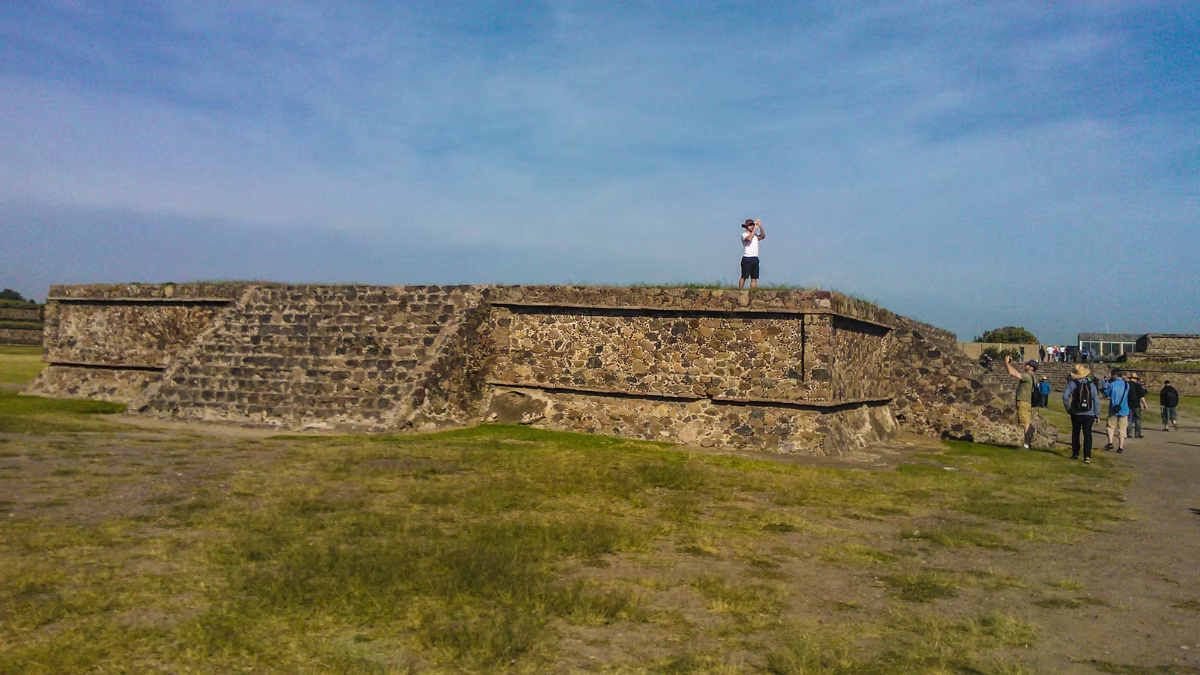
La Ciudadela (the Citadel) is a massive enclosed compound at the southern end of the Avenue of the Dead — one of the largest architectural complexes in the ancient Americas, covering approximately 160,000 square metres. At its centre stands the Temple of Quetzalcóatl, the most ornately carved structure at Teotihuacan. The compound’s enclosing platforms, the interior plaza, and the pyramid itself reveal the political and ceremonial organisation of the ancient city in ways that the main pyramids alone cannot. Entry is included in the standard site ticket.
Most visitors to Teotihuacan experience La Ciudadela as an introduction — a warm-up before the main pyramids to the north. This is an understandable mistake. La Ciudadela is not a prelude; it is one of the defining architectural statements of the ancient city, a complex whose scale, function, and iconographic programme make it as significant as the Pyramid of the Sun and far more revealing of Teotihuacan’s political and ritual identity.
This guide covers the compound in full — what it is, why it was built, what the Temple of Quetzalcóatl inside it represents, and how to visit it properly.
Key Facts
| Feature | Detail |
|---|---|
| Official name | Ciudadela (Spanish: Citadel) |
| Location | Southern end of the Avenue of the Dead, accessible from Gate 1 |
| Area | Approximately 160,000 square metres |
| Enclosing platforms | Four sides, each with a central staircase |
| Central structure | Temple of Quetzalcóatl (Feathered Serpent Pyramid) |
| Construction period | Approx. 150–250 AD |
| Plaza capacity | Estimated 100,000+ people simultaneously |
| UNESCO status | Part of the Teotihuacan World Heritage Site (1987) |
What Is La Ciudadela?
La Ciudadela is a large enclosed compound at the southern end of the Avenue of the Dead. It is bounded on four sides by low platforms, each with a central staircase. At the centre of the compound stands the Temple of Quetzalcóatl. The name Ciudadela was given by Spanish conquistadors who saw the enclosing walls and interpreted them as a military fortification — a misidentification. The compound was almost certainly a major ceremonial and possibly administrative centre.
The name “Citadel” is misleading in the same way that “Avenue of the Dead” is — it is an interpretation by later visitors who had no access to the original culture’s understanding of the space. The Ciudadela’s enclosing platforms are not defensive walls; they are ceremonial boundaries that define a sacred interior precinct. Their function was to contain and frame the Temple of Quetzalcóatl, and to create an interior plaza capable of holding the entire population of the city for major ceremonies.
The Ciudadela sits directly opposite the Gran Conjunto (Great Compound) — an equally large platform complex on the other side of the Avenue of the Dead believed to have functioned as the city’s central marketplace. Together, the Ciudadela and the Gran Conjunto create a paired monumental complex that anchors the southern end of the avenue and establishes the scale of what follows northward.
The Scale of the Compound
The scale of La Ciudadela is difficult to appreciate from within it — the enclosing platforms are low and the interior plaza is so large that the Temple of Quetzalcóatl at its centre appears smaller than it is. Understanding the numbers helps: the interior plaza covers an area approximately equivalent to eight football fields. The enclosing platforms on each side are approximately 400 metres long. The whole complex is large enough that the entire population of ancient Teotihuacan — estimated at 100,000 to 200,000 people — could theoretically have assembled inside.
This capacity is believed to be intentional. The Ciudadela was the venue for the large-scale public ceremonies that were central to Teotihuacan’s political and religious life — rituals that required the gathering of the entire urban population in a single space under the authority of the city’s ruling class.
The Temple of Quetzalcóatl Inside La Ciudadela
The centrepiece of La Ciudadela is the Temple of Quetzalcóatl — the most ornately decorated structure at Teotihuacan and the one that reveals the most about the city’s religious and political ideology.
The temple’s facade is covered in alternating carved heads of two deity types — the feathered serpent and the rain deity (Tlaloc) — arranged in a rhythmic pattern across each stepped terrace. The undulating bodies of serpents in relief connect the heads across the facade surfaces. The original colours — red, green, yellow, and black — were vivid; traces of paint survive on the most protected sections.
Beneath the temple, a 103-metre tunnel was discovered in 2003 leading to underground chambers containing extraordinary ritual deposits — golden spheres, jade figures, obsidian objects, and other offerings. The tunnel represents a symbolic underworld connected to the political authority of Teotihuacan’s rulers and is still under active excavation.
For the full Temple of Quetzalcóatl guide, see our dedicated article: Temple of Quetzalcóatl.
The Adosada Platform
Like the Pyramid of the Moon, the Temple of Quetzalcóatl has an adosada — a later platform built against its south face that partially obscures the original sculptural facade. The adosada was added approximately 100–150 years after the original temple construction.
The partially obscured sections of the original facade visible from the sides of the adosada are among the best places to appreciate the full depth and quality of the carvings. Look carefully at the sides of the adosada where it meets the original temple face — the contrast between the plain adosada surface and the elaborately carved original facade makes the iconographic programme even more striking.
How to Visit La Ciudadela
Enter through Gate 1 — La Ciudadela is directly accessible from the main entrance, immediately to the left after passing through the turnstiles. From Gate 1 to the Ciudadela entrance is less than a 5-minute walk.
Walk the perimeter first. Before approaching the Temple of Quetzalcóatl, walk along the interior of the enclosing platforms to understand the compound’s full scale. The view from the top of any of the enclosing platform staircases gives the best overview of the interior plaza and the Temple of Quetzalcóatl’s position within it.
Spend at least 30–45 minutes here. Most group tours spend 10–15 minutes at La Ciudadela before moving north to the main pyramids. This is insufficient time to examine the temple facade properly, walk the compound perimeter, or absorb the spatial quality of the interior plaza. Allow at minimum 30 minutes — ideally 45.
Stand close to the facade. The feathered serpent and rain deity carvings reward close examination — within 2–3 metres of the temple face. At this distance the depth of the relief carving, the quality of the stonework, and the articulation of individual serpent scales and feather details become fully apparent. From the far side of the plaza, the temple reads as a series of projecting heads; up close, it reads as one of the great sculptural achievements of the ancient Americas.
Visit early. La Ciudadela receives morning shade from its enclosing platforms — it is slightly cooler in the first hour after opening than the exposed Avenue of the Dead. Starting here at 8:00 AM before moving north is both the logical narrative sequence and the most comfortable thermal choice.
For a full recommended route through the site, see our Teotihuacan Pyramids map guide.
Frequently Asked Questions
What is La Ciudadela used for at Teotihuacan?
La Ciudadela was a major ceremonial compound in ancient Teotihuacan — its large interior plaza could accommodate the entire city population for mass rituals, and the Temple of Quetzalcóatl at its centre was one of the most important ritual structures at the site. Today it is an open archaeological area included in the standard site ticket.
Is La Ciudadela worth visiting?
Absolutely — it is one of the most significant and underappreciated areas of the site. The Temple of Quetzalcóatl is the most ornately decorated structure at Teotihuacan and the one with the most direct visual connection to the city’s religious symbolism. Most visitors who rush through La Ciudadela to reach the main pyramids later wish they had spent more time here.
Why is it called La Ciudadela (the Citadel)?
The name was given by Spanish conquistadors who interpreted the enclosing platforms as defensive walls — a military fortification or citadel. This is a misidentification; the compound was a ceremonial precinct, not a fortress. The name has endured in the same way that the Aztec names Avenue of the Dead and Pyramid of the Sun have endured — imprecise but historically entrenched.
Is La Ciudadela the same as the Temple of Quetzalcóatl?
No — La Ciudadela is the entire enclosed compound, and the Temple of Quetzalcóatl is the pyramid structure at its centre. The Ciudadela includes the enclosing platforms, the interior plaza, subsidiary platforms, and the temple. The temple is the most significant element of the compound but is a component of it rather than synonymous with it.
How long should I spend at La Ciudadela?
At minimum 30 minutes. Forty-five minutes is better — enough to walk the compound perimeter, examine the temple facade from close range, and absorb the spatial quality of the interior plaza.
