
Pyramid of the Moon: Complete Guide
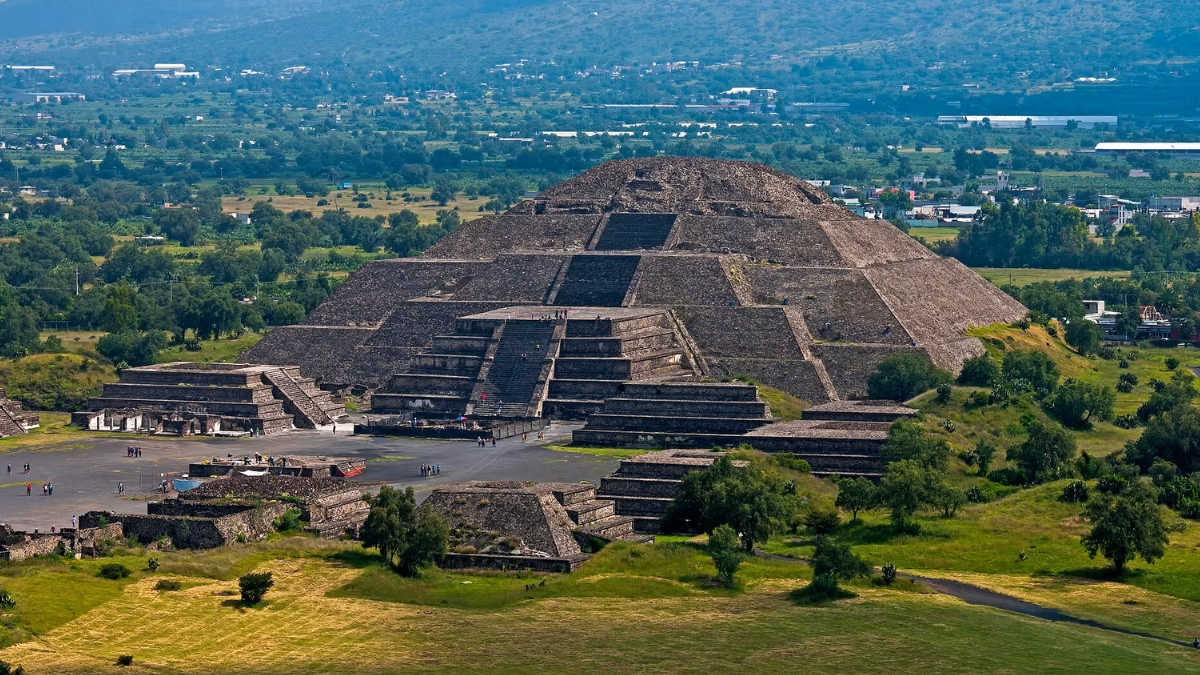
The Pyramid of the Moon stands 43 metres tall at the northern end of the Avenue of the Dead and is the second-largest structure at Teotihuacan. It currently permits climbing to its upper platforms, offering the best panoramic views of the entire site — the full length of the Avenue of the Dead, the Pyramid of the Sun to the south, and the Teotihuacan Valley beyond. The Plaza de la Luna in front of the pyramid is one of the most atmospheric spaces in the archaeological zone. Entry is included in the standard site ticket (MXN 90).
The Pyramid of the Moon anchors the northern end of Teotihuacan with a quiet authority that is distinct from the raw scale of its larger neighbour to the south. It is smaller than the Pyramid of the Sun, but many visitors who have stood on both say the Moon Pyramid offers the better experience — a more manageable climb, a more intimate summit, and a view that encompasses the entire ancient city in a single extraordinary panorama.
The plaza in front of it — the Plaza de la Luna — is framed by smaller platforms and altars and is one of the spaces in the archaeological zone where the scale and intention of the ancient urban design is most legible. Standing at the base of the Moon Pyramid, looking south along the full 2.4-kilometre length of the Avenue of the Dead, is one of the defining moments of any Teotihuacan visit.
Key Facts
| Feature | Detail |
|---|---|
| Height | 43 metres (141 feet) |
| Base dimensions | 150 × 130 metres |
| Number of terraces | 4 main terraces + adosada platform |
| Construction period | Approx. 100–450 AD (multiple phases) |
| Orientation | South-facing, aligned along the Avenue of the Dead |
| Current climbing access | Yes — upper platforms accessible |
| UNESCO status | Part of the Teotihuacan World Heritage Site (1987) |
History and Significance
The name was given by the Aztecs who visited the long-abandoned city and incorporated it into their own religious cosmology, associating it with the moon goddess Metztli. The original name used by Teotihuacan’s builders is unknown — their language and identity remain one of archaeology’s great unsolved mysteries. The pyramid’s alignment and associated ritual deposits suggest it was dedicated to a great goddess or water deity rather than specifically to the moon.
The Pyramid of the Moon was constructed in at least six distinct phases over a period of approximately 350 years, from around 100 to 450 AD. Each phase added a new outer shell over the existing structure — a common technique in Mesoamerican architecture where new construction literally encases the previous form. This means the current visible pyramid contains within it a sequence of earlier, smaller pyramids.
Archaeological excavations beneath the Pyramid of the Moon — particularly work conducted by Saburo Sugiyama and Rubén Cabrera Castro in the late 1990s and early 2000s — revealed a series of ritual burial chambers containing extraordinary offerings: human sacrifices, animal remains (eagles, jaguars, pumas, serpents, and wolves), obsidian objects, and greenstone figures. These discoveries transformed scholarly understanding of Teotihuacan’s ritual life and provided the first direct evidence of the kind of sacrificial practices that the city’s planners embedded into its most important structures.
At the time of Teotihuacan’s peak — between approximately 200 and 550 AD — the city was home to between 100,000 and 200,000 people, making it one of the largest urban centres in the ancient world. The Pyramid of the Moon stood at the visual terminus of the city’s central axis, visible from every point along the Avenue of the Dead and from the surrounding valley.
Architecture and Design
The Pyramid of the Moon is smaller than the Pyramid of the Sun but was constructed so that their summits are at the same elevation above the valley floor — an intentional design choice that required the Moon Pyramid to be built on higher ground, and that creates a visual equivalence between the two structures when seen from within the site.
The adosada platform: The most distinctive architectural feature of the Pyramid of the Moon is the adosada — a large stepped platform attached to the pyramid’s south face that projects into the Plaza de la Luna. This addition was built in the 4th century AD and fundamentally changed the visual relationship between the pyramid and the plaza. The staircase that visitors climb today runs up the face of the adosada rather than the original pyramid behind it.
The Plaza de la Luna: The plaza in front of the pyramid is not simply an open space — it is a carefully designed ceremonial precinct bounded by a series of smaller platforms arranged in a cross pattern. These platforms, combined with the main pyramid and the adosada, create an enclosed sacred space that archaeologists interpret as one of the primary ritual centres of the ancient city. The geometric precision of the plaza’s layout is best appreciated from the upper platforms of the pyramid itself.
Astronomical alignment: The Pyramid of the Moon’s north–south axis aligns with the Avenue of the Dead and contributes to the overall astronomical grid of the city. The Teotihuacan grid is oriented 15.5 degrees east of north — a deviation from cardinal directions that is believed to encode astronomical relationships with the Pleiades and with the setting point of the sun on specific calendar dates.
The View From the Top
The upper platforms of the Pyramid of the Moon offer what is widely considered the best panoramic view available at Teotihuacan. From this vantage point, the entire urban layout becomes legible in a single glance:
- The full 2.4-kilometre length of the Avenue of the Dead running south from the plaza below
- The Pyramid of the Sun on the eastern side of the Avenue — its full scale visible in relation to the surrounding structures
- The Ciudadela at the southern end of the Avenue, the low profile of its enclosure walls visible from this distance
- The geometric arrangement of the Plaza de la Luna’s smaller platforms immediately below
- The Teotihuacan Valley extending to the surrounding mountain ranges — including Cerro Gordo to the north, which the pyramid’s axis is believed to have been designed to frame
Many guides describe the view from the Moon Pyramid as the moment when Teotihuacan becomes comprehensible — when the city ceases to be a collection of individual structures and reveals itself as a single, coherently designed urban environment.
Climbing the Pyramid of the Moon
The Pyramid of the Moon currently permits climbing to its upper platforms. This makes it the most reliably accessible of the main pyramids at the site, as the Pyramid of the Sun has had variable access restrictions in recent years. Verify the current access situation on arrival.
The climb is less demanding than the Pyramid of the Sun — the Moon Pyramid is 22 metres shorter and the adosada staircase, while steep, is more manageable than the Sun’s face. At a steady pace, the ascent takes approximately 10–15 minutes.
On the stairs: The steps are steep and worn. Wear closed-toe shoes with a good grip — sandals are not safe on the pyramid stairways. Hold younger children’s hands at all times. Descend carefully, particularly if you are not accustomed to steep, narrow steps on uneven stone. Facing the pyramid rather than the valley on the descent is safer for many visitors.
At the top: The upper platform is open and exposed — no railings or shade. Bring water, wear a hat, and apply sunscreen before climbing. The platform offers 360-degree views; take time to look in every direction before descending.
The Plaza de la Luna
The Plaza de la Luna deserves as much time as the pyramid itself. The space is framed by four platforms on the north side (immediately flanking the adosada), a series of smaller altars in the centre, and the Avenue of the Dead opening to the south.
Stand in the centre of the plaza and face south: the avenue stretches away between its flanking platforms, the Pyramid of the Sun rises on the right, and the geometry of the entire city’s plan is visible as a single composition. This is the viewpoint from which ancient Teotihuacan was experienced at its most monumental — and it remains one of the most powerful urban spaces in the Americas.
Archaeologists have found evidence of significant ritual activity in the plaza — offerings, burial deposits, and the remains of what may have been large-scale ceremonies involving the whole urban population. The small altar at the centre of the plaza was almost certainly used for these purposes.
Best Time to Visit
The Pyramid of the Moon faces south, which means its main staircase and the Plaza de la Luna are in morning shadow for the first hour after the site opens — useful in the hot season when early shade is welcome. By mid-morning, the sun has moved to illuminate the plaza fully.
For photography, the Pyramid of the Moon looks best in afternoon light, when the sun is to the west and illuminates the pyramid’s south face and staircase directly. The view from the summit looks south along the Avenue of the Dead — also at its best in afternoon light, when the shadows of the flanking platforms create strong graphic contrasts along the avenue’s length.
For the least crowded conditions at any time of year, arriving at the 8:00 AM opening is the most effective strategy. For full seasonal and timing guidance, see our best time to visit guide.
How to Get There
The Pyramid of the Moon is most conveniently reached through Gate 4, which is the northern entrance and deposits visitors close to the Plaza de la Luna. From Gate 1 (the main entrance), the Pyramid of the Moon is at the far northern end of the site — approximately a 35–45 minute walk north along the full length of the Avenue of the Dead.
A logical visit route from Gate 1 covers the Temple of Quetzalcóatl first, then walks north along the Avenue to reach the Pyramid of the Moon last — ending with the panoramic view from the summit before returning south. For the full site layout, see our Teotihuacan Pyramids map guide.
Frequently Asked Questions
How tall is the Pyramid of the Moon?
43 metres (141 feet). It is the second-largest structure at Teotihuacan after the Pyramid of the Sun (65 metres). Despite the height difference, their summits are at the same elevation above the valley floor — the Moon Pyramid is built on higher ground, an intentional design choice.
Is the view from the Pyramid of the Moon better than from the Pyramid of the Sun?
Many visitors think so. The Moon Pyramid’s position at the northern end of the Avenue of the Dead means that from its summit, you look south along the full length of the avenue with the Pyramid of the Sun visible to the right — a composition that reveals the entire city’s plan in a single view. The Sun Pyramid’s summit view is more panoramic of the valley; the Moon Pyramid’s view is more revealing of the ancient city’s design.
What was found under the Pyramid of the Moon?
Excavations revealed a series of ritual burial chambers containing human and animal sacrifices, obsidian objects, greenstone figures, and other offerings. At least six distinct burial deposits have been found in chambers beneath the pyramid, associated with specific construction phases. These discoveries established that the Pyramid of the Moon was used for large-scale sacrificial rituals throughout the city’s occupation.
How long does it take to climb the Pyramid of the Moon?
The ascent takes approximately 10–15 minutes at a steady pace. The descent takes similar time. Take it slowly on the stairs — they are steep and worn.
Is the Pyramid of the Moon worth visiting if you have already seen the Pyramid of the Sun?
Absolutely. The two pyramids offer fundamentally different experiences. The Sun Pyramid is about scale and mass. The Moon Pyramid is about the view and the relationship to the urban plan. The Plaza de la Luna is also distinct from the Sun’s immediate surroundings — more enclosed, more atmospheric, and in many ways more evocative of the ancient city’s ceremonial life.
What is the adosada platform on the Pyramid of the Moon?
The adosada is a large stepped platform added to the south face of the Pyramid of the Moon around the 4th century AD. It was built in front of the original pyramid and is what visitors climb today — the staircase runs up the adosada rather than the original structure behind it. This type of addition — a new outer construction encasing the original — was a common practice in Mesoamerican pyramid architecture.
