
What's Inside the Teotihuacan Pyramids
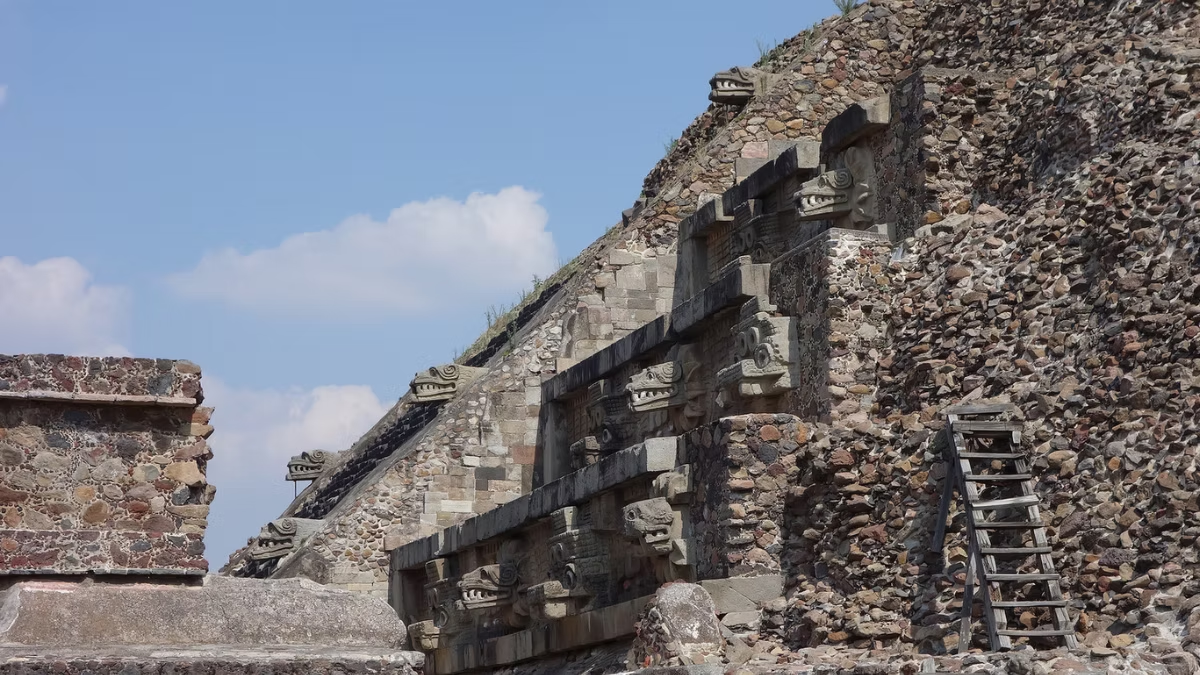
The Teotihuacan Pyramids are not hollow in the way that some Egyptian pyramids are. They are composed primarily of earth and rubble fill, faced with stone. However, beneath and within them lies an extraordinary underground landscape: a natural cave runs 100 metres beneath the Pyramid of the Sun; a 103-metre artificial tunnel beneath the Temple of Quetzalcóatl leads to underground chambers with remarkable ritual deposits; and a series of burial chambers beneath the Pyramid of the Moon contain human sacrifice deposits and offerings. An extensive tunnel network also runs beneath the wider site, still under active excavation.
The surface of Teotihuacan is extraordinary — the Pyramid of the Sun, the Avenue of the Dead, the Temple of Quetzalcóatl facade. But what lies beneath the surface has proven, in many ways, to be even more significant. The underground discoveries made at Teotihuacan over the past four decades have transformed scholarly understanding of the city and continue to generate some of the most important archaeological findings made anywhere in the world.
This article brings together everything currently known about what is inside and beneath the Teotihuacan Pyramids — the natural formations, the constructed tunnels, the sacrificial burial chambers, and the ongoing excavations that continue to expand the picture.
The Pyramid Structure: What They Are Made Of
The pyramids are composed of layers of earth, rubble, and volcanic stone, faced with a layer of cut stone and originally coated in plaster. They are not hollow structures — unlike some Egyptian pyramids which contain internal passages, chambers, and burial rooms, the Teotihuacan Pyramids are essentially solid fills with an outer casing. The underground spaces associated with them are beneath the pyramids, not inside them.
The construction of the Pyramid of the Sun required an estimated 1.2 million cubic metres of fill material — earth, rubble, and broken stone — moved and deposited without wheels, draft animals, or iron tools. The outer face was then covered in cut stone blocks and finished with a plaster coating that was painted. Traces of red pigment survive on the most protected surfaces.
This construction method — rubble core with stone facing — is fundamentally different from the internal chamber architecture of Egyptian pyramids. At Teotihuacan, the significant spaces are underground, not above ground within the structures.
The Cave Under the Pyramid of the Sun
A natural lava tube runs approximately 100 metres beneath the Pyramid of the Sun, extending into four chambers at its end. The cave was discovered in 1971 during drainage work. It is believed to have been a significant sacred space before the pyramid was built above it — possibly representing the underworld or a place of creation — and the pyramid may have been deliberately sited to mark and amplify this pre-existing sacred geography.
The cave was found to contain offerings — pottery, obsidian, and ritual objects — confirming that it was actively used for ceremonies. The relationship between the cave and the pyramid above it remains one of Teotihuacan’s most intriguing unresolved questions: did the builders choose this specific location because the cave was already sacred, or did the cave’s ritual significance develop after the pyramid was constructed above it?
The cave passages extend outward in a cruciform pattern — four tunnels radiating from a central chamber — a spatial arrangement that some researchers interpret as representing the four cardinal directions and the cosmological centre of the world. If so, the pyramid was built at the literal centre of the ancient Teotihuacanos’ cosmological universe.
Is the cave open to visitors? No. The cave beneath the Pyramid of the Sun is not accessible to visitors. It is currently used as a drainage system and remains the subject of ongoing research. The site museum near Gate 5 provides some context for the cave’s discovery and significance.
The Tunnel Beneath the Temple of Quetzalcóatl
In 2003, researchers discovered a sealed tunnel entrance beneath the adosada staircase of the Temple of Quetzalcóatl. The tunnel runs 103 metres to a set of underground chambers. Excavations led by archaeologist Sergio Gómez Chávez found: hundreds of spheres coated in jarosite mineral to produce a golden appearance, jade figures, obsidian objects, shells, rubber balls, pyrite mirrors, animal bones, and the remains of wooden structures. The chambers appear to represent a symbolic underworld — possibly connected to the royal burial or investiture rituals of Teotihuacan’s rulers.
The tunnel discovery transformed understanding of the Temple of Quetzalcóatl. The structure was already known to be associated with large-scale human sacrifice — over 200 sacrificial burials were found in its construction fill in the 1980s. The tunnel revealed a different, deeper layer of ritual: a deliberately constructed underground world that mirrored or represented the overworld of the pyramid above.
The golden spheres are among the most visually arresting finds. Hundreds of spheres — ranging from a few centimetres to over 10 centimetres in diameter — were found arranged in specific spatial patterns across the tunnel floor and chambers, coated in jarosite to produce a metallic golden sheen. Whether they represent seeds, stars, a cosmological map, or something else entirely remains debated. Their careful production and arrangement indicates a high level of intentionality.
Liquid mercury was also found in the tunnel’s chambers — pools of elemental mercury used as a reflective surface, possibly representing a subterranean lake or the underworld’s primordial waters. Mercury has been found at several Mesoamerican sites in ritual contexts; at Teotihuacan the quantities are the largest found anywhere in the ancient Americas.
Is the tunnel open to visitors? No. The tunnel is under active excavation by INAH’s research team. Access is restricted to researchers. The excavation is ongoing as of 2025.
The Burial Chambers Beneath the Pyramid of the Moon
Excavations conducted between 1998 and 2004 by archaeologist Saburo Sugiyama revealed a series of ritual burial chambers at different depths beneath the Pyramid of the Moon, associated with each of the pyramid’s main construction phases. Each chamber contained human sacrificial victims, animal remains (eagles, jaguars, pumas, serpents, wolves, and owls), obsidian objects, greenstone figures, and other offerings.
At least six distinct burial deposits have been identified beneath the Pyramid of the Moon, each corresponding to a specific construction phase spanning approximately 350 years. The deposits were not random — they were carefully organised, with specific animal species placed in specific positions suggesting a cosmological arrangement rather than simply a mass interment.
The animal species included are particularly significant: eagles, jaguars, pumas, wolves, owls, and serpents are all animals associated with specific deities, directions, and cosmological roles in Mesoamerican religious systems. Their deliberate inclusion and arrangement alongside human victims indicates that each burial deposit was a complex ritual event — not simply a sacrifice but a cosmological statement embedded into the pyramid’s construction.
Is the burial chamber area open to visitors? No. The burial chambers beneath the Moon Pyramid are not accessible. The pyramid itself can be partially climbed, but the underground excavation areas are closed to the public.
The Broader Tunnel Network
Beyond the individual structures, Teotihuacan has an extensive tunnel network running beneath the site. These tunnels were originally constructed for multiple purposes — drainage, quarrying of fill material during construction, and possibly ritual use.
Ongoing LIDAR surveys and ground-penetrating radar investigations have revealed that the tunnel network is far more extensive than previously known. Portions of it have been accessible during specific INAH excavation programmes and on the La Gruta tour format (which includes access to an underground section of the site). For more on this tour, see our Teotihuacan Pyramids Tour with La Gruta Restaurant guide.
What All of This Tells Us
The underground discoveries at Teotihuacan collectively reveal something that the surface architecture alone does not: the ancient city was built on a deliberate symbolic geography in which the underworld — represented by natural caves and constructed tunnels — was as important as the overworld of the pyramid platforms above.
The cave beneath the Pyramid of the Sun, the tunnel beneath the Temple of Quetzalcóatl, the burial chambers beneath the Pyramid of the Moon — in each case, the underground space is not incidental to the pyramid above it. It is the foundation of its meaning. The pyramids were built to mark, amplify, and access sacred underground spaces, creating a vertical axis from the cosmological underworld below to the celestial realm above. The ancient city was constructed as a machine for mediating between these two worlds — with the living city, its population, and its rulers occupying the space in between.
This understanding transforms the experience of walking the Avenue of the Dead — you are walking above a hidden landscape that was as carefully designed as everything visible above the surface.
Frequently Asked Questions
Are any of the underground areas open to visitors?
Limited sections of the site’s tunnel network are accessible on specific tour formats — particularly the La Gruta tour which includes a visit to an underground section of the archaeological zone. The caves under the Pyramid of the Sun, the tunnel beneath the Temple of Quetzalcóatl, and the burial chambers beneath the Pyramid of the Moon are all closed to the public.
Why was liquid mercury found under the Temple of Quetzalcóatl?
Mercury in ritual contexts appears at several Mesoamerican sites, including Maya sites in Guatemala and Belize. At Teotihuacan, the mercury pools are believed to represent a symbolic subterranean body of water — possibly an underworld lake or ocean. Mercury’s reflective quality (it mirrors the sky when still) and its liquid metal nature may have given it a specific cosmological significance relating to the boundary between the living world and the underworld.
Is there anything inside the Pyramid of the Sun?
The pyramid itself is essentially solid fill — not hollow. The significant underground space associated with it is the natural lava tube cave discovered in 1971, which runs beneath the pyramid and was almost certainly the reason this specific location was chosen for the pyramid’s construction. The cave is not accessible to visitors.
Have any royal tombs been found at Teotihuacan?
Not definitively. The tunnel beneath the Temple of Quetzalcóatl is the most likely candidate for a royal burial or investiture site — its contents and spatial arrangement suggest a connection to political authority — but no clearly identified royal tomb has been confirmed. This is one of the most active areas of ongoing research.
What is still being excavated at Teotihuacan?
The tunnel beneath the Temple of Quetzalcóatl is still under active excavation. The broader tunnel network identified by ground-penetrating radar surveys has not been fully explored. INAH publishes research updates on inah.gob.mx for those following the excavations.
