
Teotihuacan with Kids: A Family Guide
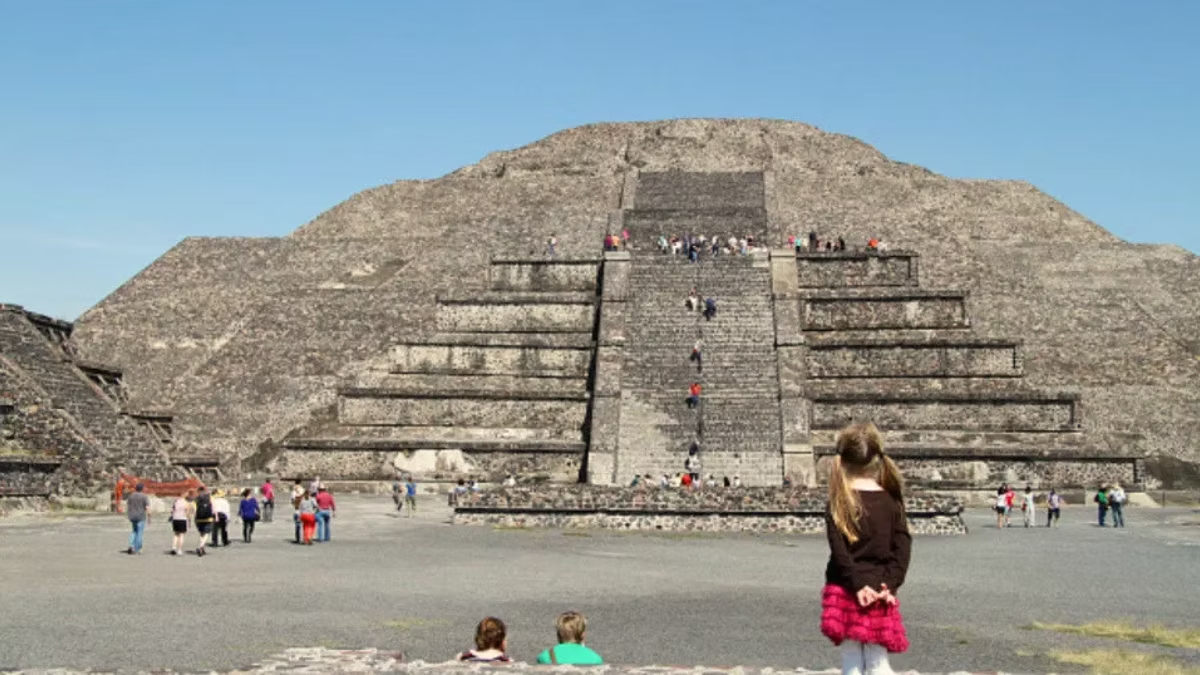
Teotihuacan is an excellent destination for families with children aged 5 and above. Children can climb the Pyramid of the Moon (access permitted) and explore the site freely. The main challenges are heat, walking distance (4–6 km), and uneven terrain. An early morning visit, plenty of water, and a guide who can engage children with storytelling makes a significant difference. Entry is free for children under 13.
Some of the most extraordinary family days in Mexico happen at Teotihuacan. Children respond to the sheer scale of the pyramids in a way that is genuinely delightful to witness — the Pyramid of the Sun is not an abstract historical fact when you are standing at its base looking up at 65 metres of ancient stone. The climb, the view from the top, the stories of gods and astronomy and ancient cities — Teotihuacan has a natural drama that engages children in a way that many heritage sites do not.
With the right preparation, a family visit to Teotihuacan is one of the highlights of a Mexico trip for adults and children alike. This guide covers everything you need to plan it well.
Is Teotihuacan Suitable for Children?
Teotihuacan is an excellent destination for children aged 5 and above. The site is open-air and physically active, which suits children better than enclosed museums. Children under 13 enter free every day. The main considerations are heat, walking distance, and the steep pyramid stairs, all of which are manageable with the right preparation.
Best age range: 5–16 years old. Children younger than 5 can enjoy the experience but will need to be carried for parts of the visit — the terrain is not pushchair-friendly across the site.
Toddlers and babies: A structured baby carrier works well for children too young to walk the distance. Most pushchairs and strollers are impractical on the uneven stone surfaces, particularly near the pyramids. A lightweight umbrella stroller can navigate some of the flatter sections near Gate 1 but will struggle on the raised platforms.
Teenagers: Teotihuacan is an excellent destination for teenagers — the combination of physical activity (climbing, walking), visual scale, and genuinely compelling history makes it more engaging than many cultural sites that can feel remote or abstract to younger visitors.
Admission for Children
Children under 13 (Mexican nationals and foreigners) enter the Teotihuacan Archaeological Zone free every day. This applies at all five entry gates. Proof of age is not typically required for young children, but having a passport or birth certificate available for older children who look close to 13 is a sensible precaution.
For families, this makes the gate ticket essentially free for the children — the adults pay MXN 90 each, and children under 13 enter at no cost. See our entry ticket guide for full admission details.
Can Children Climb the Pyramids?
Pyramid climbing is one of the main attractions for children at Teotihuacan — and for good reason. The Pyramid of the Moon currently has access to its upper levels available (access policies can change — verify when you arrive). The Pyramid of the Sun has historically permitted climbing to the summit, though access has varied in recent years and may be restricted during certain periods.
Safety on the stairs: The pyramid stairs at Teotihuacan are steep, narrow, and worn. Children need closed-toe shoes with a good grip — sandals and flip-flops are not safe on the pyramid faces. Hold the chains or ropes provided on some staircases. Younger children (under 8) should climb with a hand held by an adult at all times.
Coming down: Many visitors find descending more challenging than ascending. Teach children to descend sideways or facing the pyramid rather than forward-facing if they feel unstable. Take it slowly — there is no rush.
Not mandatory: Climbing the pyramids is never required to have a meaningful visit. The structures are impressive and worth significant time at their bases. Children who are nervous about heights or steep stairs should not be pressured to climb.
Best Tour Format for Families
Guided Tour with a Family-Friendly Guide
A guided tour is strongly recommended for families visiting Teotihuacan for the first time. A good guide who is experienced with mixed-age groups frames the history as stories rather than lectures — the gods, the mystery of who built the city and where they went, the astronomical precision of the pyramid alignments, the significance of the Avenue of the Dead‘s name. Children engage with narrative in a way they rarely do with bare historical facts.
When booking a guided tour with children, look for operators who specify family-friendly formats or who explicitly mention experience guiding groups with children.
Early Access Tour
The early access tour is particularly good for families with children. The early departure (6:20 AM) and arrival at opening means the site visit is completed before the peak heat of the day and before the largest crowds arrive. Children are generally more energetic and engaged in the morning than the afternoon, and completing the visit before the sun is fully overhead significantly reduces the heat exhaustion risk.
The early return time — back in Mexico City by 1:00–2:00 PM — also leaves the afternoon free for rest or lower-intensity activities, which is useful when travelling with children who have been active since early morning.
Private Tour
For families who want maximum flexibility — the ability to stop when children need a rest, spend extra time at structures that capture their attention, and move on quickly from things that do not — the private tour is the best format. Hotel pickup is included, the guide’s full attention is on your family, and the itinerary adapts entirely to the group’s pace and interests.
For families with toddlers or children with special needs, the private format is strongly recommended over shared group tours.
Timing and Practical Tips for Families
Arrive early. The first 90 minutes after the 8:00 AM opening are the best for families — coolest temperatures, smallest crowds, most energetic children. For more on the best arrival strategy, see our best time to visit guide.
Plan for 3–4 hours. This is the right length for most families with school-age children. Enough to cover the main highlights fully without exhausting younger visitors. For guidance on what is achievable in different time windows, see our how much time you need guide.
Build in rest stops. The plazas along the Avenue of the Dead have some areas where children can sit, run around, and decompress between structures. Forcing a march from pyramid to pyramid without pauses is a reliable way to make children miserable regardless of how impressive the surroundings are.
Keep children engaged with questions and stories. Teotihuacan responds well to the “what do you think?” approach with children. Why do you think the ancient people built the pyramid so big? What would it have been like to live in a city of 100,000 people with no cars? How do you think they moved stones this heavy without machines? The mystery and scale of the site generate genuine curiosity in children when framed the right way.
Watch carefully on the pyramid stairs. The stairs are genuinely steep and worn. Keep younger children close on the ascent and especially the descent. Do not let children run on the stairways.
What to Pack for a Family Visit
- Minimum 1 litre of water per child (more in hot weather)
- Closed-toe shoes for all children — mandatory for pyramid climbing
- High-SPF children’s sunscreen applied before departure
- Sun hats for all children
- Familiar snacks to prevent hunger-driven meltdowns mid-visit
- A baby carrier for children under 3 who cannot walk the full distance
- A change of light clothing in case of sweat or, in the rainy season, rain
For a full family packing checklist, see our what to wear and bring guide.
Making the Visit Engaging for Children of Different Ages
Ages 3–5: Focus on the size and shape of the pyramids — “how many of your houses stacked up would reach the top?” — and on the walking and climbing as an adventure rather than a cultural lesson. Keep the visit to 2 hours maximum.
Ages 6–9: Introduce the stories — the gods, the ancient city, the mystery of why everyone left. Children this age respond strongly to narrative. A guide who tells stories rather than delivers facts makes a dramatic difference for this age group.
Ages 10–14: Add the astronomy and engineering. The precise orientation of the Pyramid of the Sun to the setting sun on the equinox, the engineering challenge of moving millions of tonnes of stone without wheels, the murals at Tepantitla depicting paradise — these concepts engage curious pre-teens strongly.
Ages 14+: Treat teenagers as adults at the site. The history of Teotihuacan — one of the world’s great unsolved archaeological mysteries — is genuinely fascinating when presented properly. The unanswered questions (who built it? what language did they speak? why did they leave?) are more engaging to teenagers than settled historical facts.
Frequently Asked Questions
What age is Teotihuacan suitable for?
The site is enjoyable for children from age 3 upward, with the experience becoming significantly richer from age 5–6 when children can walk independently and engage with storytelling. There is no upper age limit — the site is accessible for older children and teenagers.
Is Teotihuacan safe for children?
Yes — the site is well-managed and generally safe. The main physical risks are the steep pyramid stairs (manageable with supervision) and sun exposure (manageable with sun protection). Hold younger children’s hands on stairways and apply sunscreen before entering.
Is there a playground or specific children’s area at Teotihuacan?
No. The site is an open archaeological zone — it does not have dedicated children’s facilities. The open plazas and grassy areas provide space for children to run and explore between the structured parts of the visit.
How do I keep young children entertained during a long visit?
Stories work better than facts. Build physical challenges into the visit — climbing, counting steps, spotting carvings — and make regular stops for water and snacks. A guide who is experienced with children and frames the visit as an adventure rather than a lesson makes an enormous difference.
Are there baby changing facilities at Teotihuacan?
Basic facilities are available near the main gate entrances. They are functional but limited. Bring everything you need rather than relying on on-site provision.
Can I take a pushchair / stroller to Teotihuacan?
A lightweight umbrella stroller can navigate some of the flatter sections near Gate 1, but most of the site’s terrain — particularly near the pyramids — is too uneven for a standard pushchair. A structured baby carrier is a far more practical option for children under 3.
